

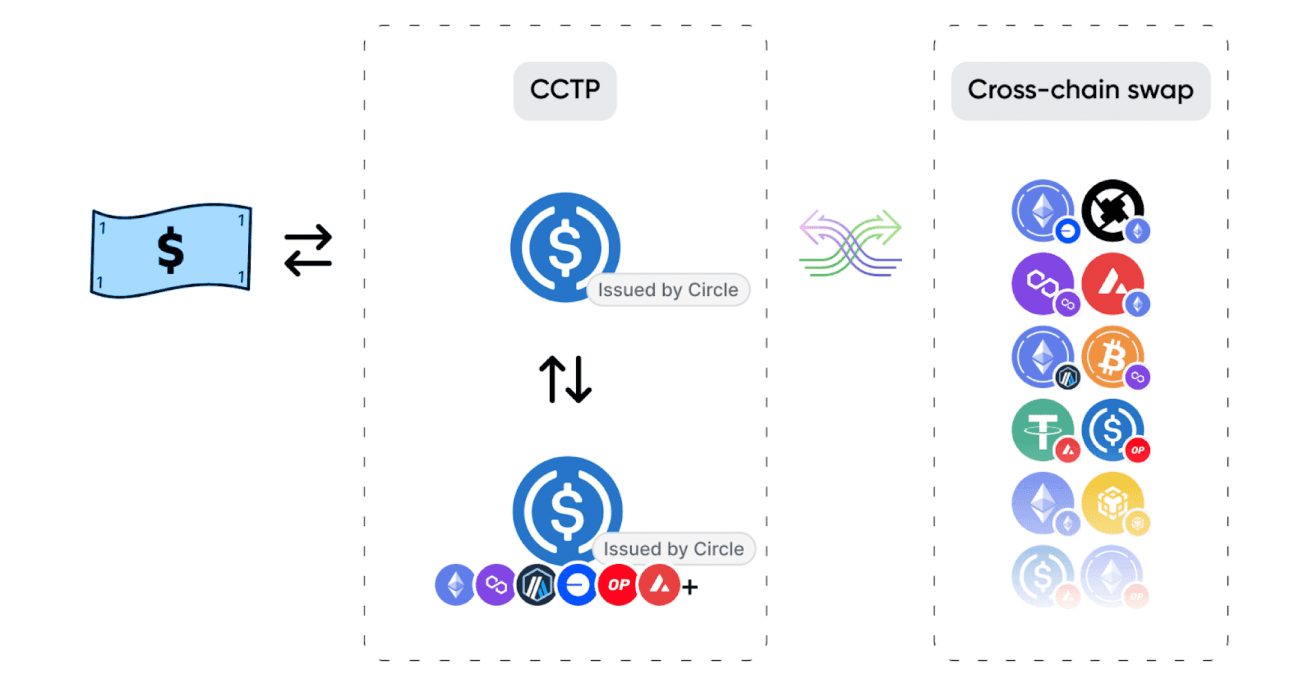
Ask a crypto-native developer the difference between native USDC and bridged USDC and they'll give you a nuanced answer about Circle's CCTP, token contracts, and chain-specific issuance. Ask an average user and they'll say: "Isn't USDC just USDC?"
That gap in understanding is where deposits go to die.
The stablecoin maze
USDC alone exists on 16+ blockchains. On some chains it's natively issued by Circle. On others it's a bridged version — USDC.e on Avalanche, USDbC on Base, and various wrapped variants elsewhere. Each has a different contract address, different liquidity, and different behavior.
Now multiply that by USDT, DAI, and every other stablecoin. Then add native tokens like ETH and SOL. Then add all the L2s.
The result is a fragmented mess that even experienced users find confusing — and it's the first thing they encounter when trying to deposit into your platform.
What users actually experience
Here's what a typical deposit looks like from the user's perspective:
- They hold USDC on Arbitrum. Your platform accepts USDC on Polygon.
- They see "USDC" on both sides and assume it'll work. It doesn't.
- They Google "how to move USDC from Arbitrum to Polygon" and land on a bridging tutorial.
- They find out there's "bridged USDC" and "native USDC" and they're not the same thing.
- They wonder if they'll lose their money. Many close the tab.
This isn't a power-user problem. This is the default experience for anyone trying to deposit into an on-chain app today. And most platforms are asking users to navigate it themselves.
It's not just stablecoins
The confusion compounds across every token type:
- "I sent USDC to the right address but on the wrong chain." Funds are stuck or lost.
- "The platform says I have 0 USDC but I can see it in my wallet." They're holding a bridged variant the platform doesn't recognize.
- "I deposited ETH but the platform wanted WETH." Wrapped vs unwrapped is invisible to most users.
- "I tried to deposit from Solana but only see Ethereum options." The user leaves.
Each of these is a real support ticket. At scale, it's thousands of them — and each one represents a deposit that almost happened but didn't.
Platforms shouldn't push this complexity to users
The underlying infrastructure is complex. Tokens exist on different chains with different standards, different contract addresses, and different bridging mechanics. That's the reality of a multi-chain world.
But none of that should be the user's problem.
The best deposit experiences abstract all of this away. The user picks what they want to deposit, confirms one transaction, and sees their balance. They never have to think about which chain their USDC is on, whether it's native or bridged, or how it gets to the platform.
How Unifold handles this
Unifold sits between the user and all of this complexity. Users deposit with whatever token they have on whatever chain they're on. Unifold routes, converts, and settles — and the platform receives exactly what it expects.
No bridging UI. No chain selection. No "which USDC is this?" confusion. Just a deposit that works.
If your platform still asks users to figure out multi-chain deposits on their own, you're losing volume to confusion. That's the problem we're solving.
Want to see what a clean deposit flow looks like? Reach out at hello@unifold.io or check our docs.